Are therapy intensives worth the investment?

Last Updated: 7/20/2026
Investing in your mental health is one of the most meaningful decisions you can make. When you’re considering a therapy intensive, it’s normal and quite honestly wise for hesitation, questions, or even guilt to show up. Many people in Pittsburgh, Memphis, and across Pennsylvania and Tennessee wonder whether a therapy intensive is worth it, whether the cost makes sense, or whether they should just stick with weekly therapy instead.
If you’re feeling unsure, you’re not alone. A therapy intensive is a significant emotional and financial investment, and it’s okay to take your time, gather information, and check in with your nervous system before making a decision. This post will help you understand what you’re actually investing in, why therapy intensives can be deeply cost‑effective, and how to discern whether this path aligns with your healing goals.
TL;DR
Therapy intensives can feel expensive upfront, but they offer focused, uninterrupted time for deep healing that often accelerates progress compared to weekly therapy.
Feeling hesitant or unsure about the cost is quite common since intensives are priced higher than weekly hour-long sessions.
When you invest in a trauma therapy intensive or EMDR intensive, you’re investing in depth, efficiency, and meaningful change.
Many clients receive out‑of‑network reimbursement, and the long‑term cost of staying stuck, burnt out, or overwhelmed is often far greater.
If you’re curious, schedule a consultation with a provider that offers intensive sessions.
Normalizing the Hesitation of Investing in a Therapy Intensive
Money and mental health are both tender topics. When they intersect, as in when you’re considering a therapy intensive, it’s common for conflicting feelings to surface.
You might notice thoughts like:
“Is this too expensive?”
“What if it doesn’t work?”
“Should I really spend this much on myself?”
“Do I deserve this level of care?”
These questions are not signs that you’re unprepared or uncommitted, but rather that you are discerning about how far your resources and options will take you.
Therapy intensives ask you to pause your routine, prioritize your healing, and invest in focused support. For many people in Pittsburgh, Memphis, and surrounding areas, that can feel both exciting and intimidating. A trauma‑informed approach recognizes that hesitation is part of the process, not a barrier to it.
Let’s explore what these concerns really mean and how to understand the value of a therapy intensive in a grounded, compassionate way.
Common Concerns About Cost
When people explore therapy intensives, financial questions are often the first to arise. These concerns are valid and deserve space.
“What if it doesn’t work?”
This is one of the most common fears. Trauma healing is not linear, and many people have had past experiences where therapy felt slow, inconsistent, or interrupted by life’s demands. It makes sense to wonder whether a concentrated approach will be different.
Therapy intensives are designed to create the conditions for deeper work: longer sessions, fewer interruptions, and a regulated therapeutic pace. Research has shown the higher efficacy of EMDR on trauma symptoms in the intensive format. While no therapist can guarantee specific outcomes, many clients experience significant shifts because the structure supports sustained focus.
“Is this too expensive?”
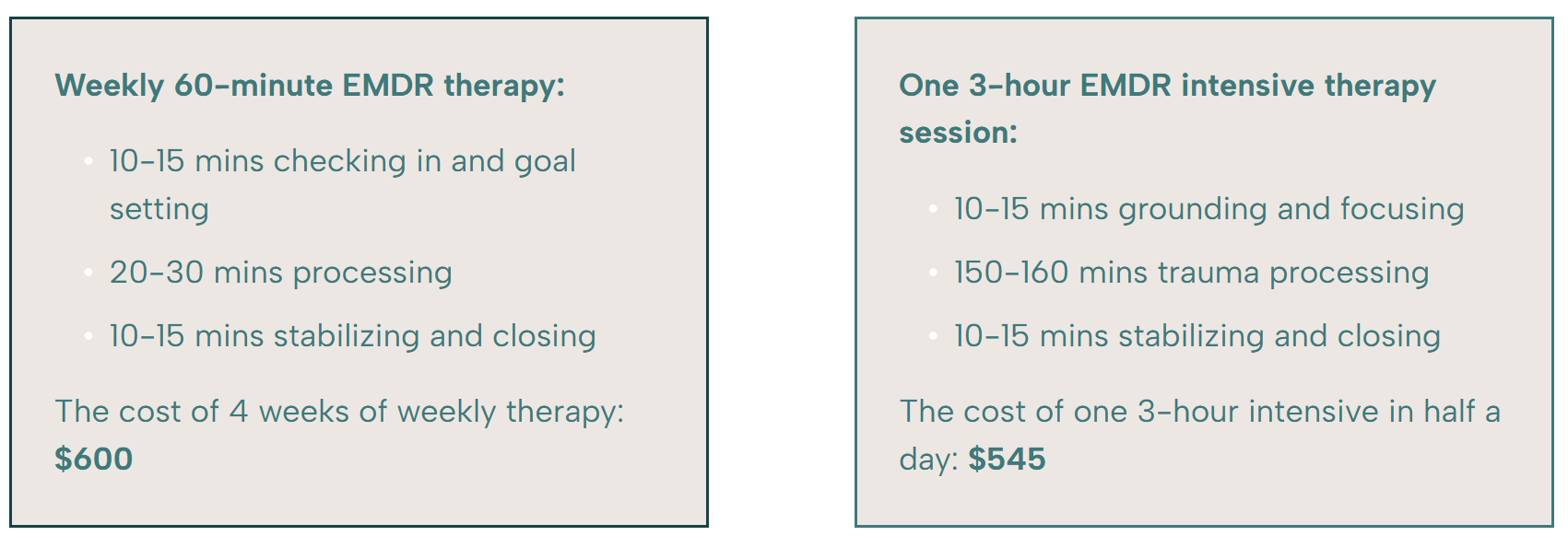
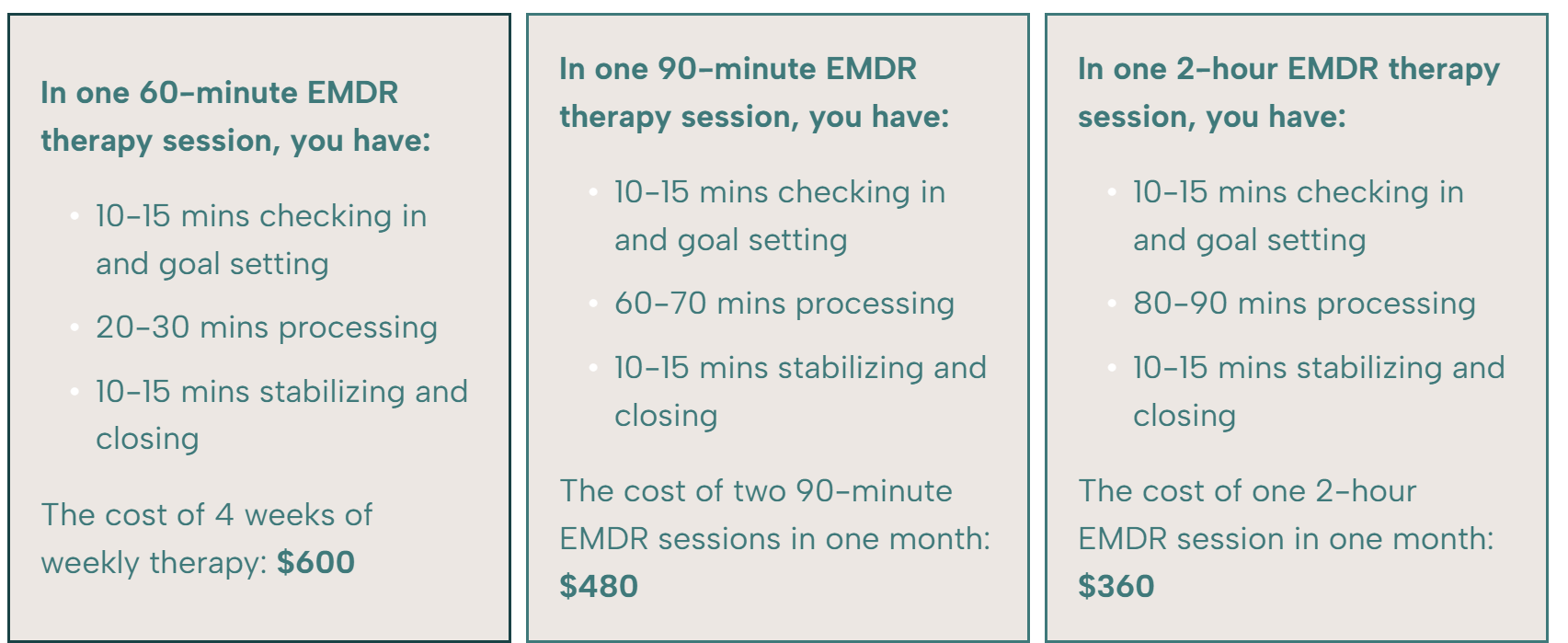
It’s natural to feel protective of your financial resources. Therapy intensives often involve several hours of EMDR, somatic work, or trauma‑informed processing in a short window of time. The upfront cost can feel larger than weekly therapy, even though the total investment may be similar, or sometimes less, over time. Keep scrolling for cost-comparison and value diagrams comparing therapy intensives & extended sessions with weekly/biweekly therapy.
“Should I just stick with weekly therapy?”
Weekly therapy is a wonderful option for many people. But if you’ve been feeling stuck, overwhelmed, or unable to go deeper because of the way time constrains you working through deeply entrenched patterns, an intensive may offer a different kind of momentum.
“What if I’m not ready?”
Readiness is not about having everything figured out. It’s about being willing to show up with curiosity and care. If you’re asking these questions, you’re already engaging thoughtfully with the process.
What You’re Actually Investing In
A therapy intensive is not just a longer therapy session. It’s a structured, intentional healing experience designed to support deep, focused work that is difficult to access in a 50‑minute weekly format.
Here are a few diagrams to help you compare the costs of weekly/biweekly EMDR therapy with intensive EMDR therapy in my practice:
Here’s what you’re truly investing in:
1. Focused, uninterrupted time
In weekly therapy, you often spend the first 10 minutes settling in and the last 10 minutes winding down. In an intensive, you have the spaciousness to stay with the work, follow your nervous system’s natural rhythm well over 30 minutes (think 160+ minutes of mind-body healing), and move through layers of healing without rushing.
2. Depth and efficiency
Trauma therapy intensives and EMDR intensives allow you to process more material in a shorter period. This can lead to:
faster relief from symptoms
deeper insight
more integrated nervous system regulation
fewer disruptions from weekly life stressors
3. A customized healing plan
Intensives are tailored to your goals, history, and nervous system needs. You’re not just receiving therapy… you’re receiving a curated healing experience.
4. A reset for your mind and body
Many clients describe intensives as a “reset button” that helps them break patterns of burnout, emotional exhaustion, or chronic stress.
5. A long‑term investment in your wellbeing
The benefits of an intensive often ripple outward into relationships, work, self‑confidence, and daily functioning. A good intensive will have you feeling its ripple effects for weeks and months.
When you invest in a therapy intensive, you’re investing in the possibility of meaningful change, not just more sessions.
How Intensives Can Be Cost‑Effective
It may seem counterintuitive, but therapy intensives can be more cost‑effective than long‑term weekly therapy.
1. You’re condensing months or years of work
Weekly therapy often progresses slowly because of time limitations. Intensives allow you to:

stay in the therapeutic window longer
process more deeply
move through stuck points more efficiently
Many clients report that a single intensive feels equivalent to several months of weekly sessions.
2. You reduce the “start‑stop” pattern
Weekly therapy can be disrupted by:
scheduling conflicts
holidays
emotional fatigue
life stressors
difficulty re‑entering deep work each week
Intensives eliminate these interruptions, which can reduce the total number of sessions needed.
3. Out‑of‑network reimbursement is often available
Many clients in Pennsylvania and Tennessee receive partial reimbursement for therapy intensives through their insurance’s out‑of‑network benefits. This can significantly reduce the overall cost.
While reimbursement is never guaranteed, superbills and documentation can make the process smoother.
4. The cost of staying stuck is often higher
This is the part we rarely talk about, but it matters.
The cost of not healing can show up as:
chronic stress or burnout
relationship strain
decreased work performance
emotional exhaustion
physical symptoms
lost time, energy, and clarity
When you invest in a therapy intensive, you’re investing in your ability to move forward with more stability, capacity, and self‑trust.
5. Intensives can reduce long‑term therapy needs
Some clients continue with weekly therapy afterward, but many find they need fewer sessions or can space them out more comfortably.
Ready to explore whether a therapy intensive is right for you?
If you’re reading this and still feeling unsure, that’s okay. You don’t have to make a decision today. A consultation is a gentle, pressure‑free way to explore whether a therapy intensive aligns with your needs, goals, and financial comfort.
Whether you’re in Pittsburgh, Memphis, or elsewhere in Pennsylvania or Tennessee, you deserve access to meaningful, effective healing. Therapy intensives can be a powerful investment in your mental health, your nervous system, and your long‑term wellbeing.
If you’re curious, have questions, or want to talk through your options, I invite you to schedule a consultation. Together, we can explore whether a trauma therapy intensive or EMDR intensive is the right next step for your healing journey.

About the Author
Chelsea Adams, LPC is a licensed therapist with over 8 years of experience supporting clients in their mental wellness. She specializes in attachment & relational trauma and race-based traumatic stress. She uses a model of evidence-based approaches such as EMDR, Somatic Internal Family Systems, Psychodynamic Psychotherapy, and therapy intensives to help clients connect to their own wisdom, voice, and power. Chelsea is committed to providing compassionate, expert care online for clients across Pennsylvania.